
Welcome to above the clouds

AWS – Amazon EKS add-ons now supports Private CA Connector for Kubernetes
Today, AWS announces the general availability of Private CA Connector for Kubernetes Amazon EKS add-on. This new integration allows customers to easily issue certificates from AWS Private Certificate Authority (AWS Private CA) to their Kubernetes clusters running on Amazon Elastic Kubernetes Service (Amazon EKS). The add-on installs and manages the Private CA Connector for Kubernetes. […]
AWS – Amazon Lex extends custom vocabulary feature to additional languages
Amazon Lex now extends custom vocabulary support to multiple languages, including Chinese, Japanese, Korean, Portuguese, Catalan, French, German, and Spanish locales. This enhancement enables you to improve speech recognition accuracy for domain-specific terminology, proper nouns, and rare words across a wider range of languages, creating more natural and accurate conversational experiences. With custom vocabulary, you […]
AWS – AWS Resource Groups adds support AWS PrivateLink
AWS Resource Group APIs now come with AWS PrivateLink support, allowing you to invoke AWS Resource Group APIs from within your Amazon Virtual Private Cloud (VPC) without traversing the public internet. AWS Resource Groups enables you to model, manage and automate tasks on large numbers of AWS resources by using tags to logically group your […]
AWS – Amazon EC2 C7a instances are now available in AWS Europe (London) Region
Starting today, the compute optimized Amazon EC2 C7a instances are now available in AWS Europe (London) Region. C7a instances, powered by 4th Gen AMD EPYC processors (code-named Genoa) with a maximum frequency of 3.7 GHz, deliver up to 50% higher performance compared to C6a instances. C7a instances offer new processor capabilities such as AVX-512, VNNI, […]
AWS – Amazon Redshift now supports increased concurrency for vacuum operations
Amazon Redshift has enhanced its vacuum operations to support increased concurrency across different tables in data warehouses. This feature reduces maintenance time and improves resource utilization by allowing multiple vacuum operations to run simultaneously. Vacuum operations maintain optimal query performance by performing two critical functions: sorting table data and reclaiming disk space from deleted rows. […]
AWS – AWS Resource Groups now supports IPv6
AWS Resource Group APIs now supports IPv6 for dual stack subnets so you can filter IPv4 and IPv6 traffic flows to and from the public internet, on-premises network, or any endpoint in your Amazon Virtual Private Cloud (VPC). AWS Resource Groups enables you to model, manage and automate tasks on large numbers of AWS resources […]
AWS – Amazon EC2 M7g instances are now available in AWS GovCloud (US-West) Region
Starting today, Amazon Elastic Compute Cloud (Amazon EC2) M7g instances are available in the AWS GovCloud (US-West) Region. These instances are powered by AWS Graviton3 processors that provide up to 25% better compute performance compared to AWS Graviton2 processors, and built on top of the the AWS Nitro System, a collection of AWS designed innovations […]

GCP – Enhancing Google Cloud protection: 4 new capabilities in Security Command Center
In today’s cloud environments, security teams need more than just surface-level visibility; they require actionable insight to ensure that their cloud workloads are safe. Unlike third-party cloud security tools that rely on data available via public APIs, Security Command Center (SCC) is built directly into Google Cloud. This gives us unmatched visibility into the safety […]

GCP – Announcing new MCP integrations to Google Cloud Databases to enable AI-assisted development
Last month at Google Cloud Next ‘25, we announced MCP Toolbox for Databases to make it easier to connect generative AI agents to databases, and automate core enterprise workflows. MCP Toolbox for Databases (Toolbox) is an open-source Model Context Protocol (MCP) server that allows developers to easily connect gen AI agents to enterprise data. It […]
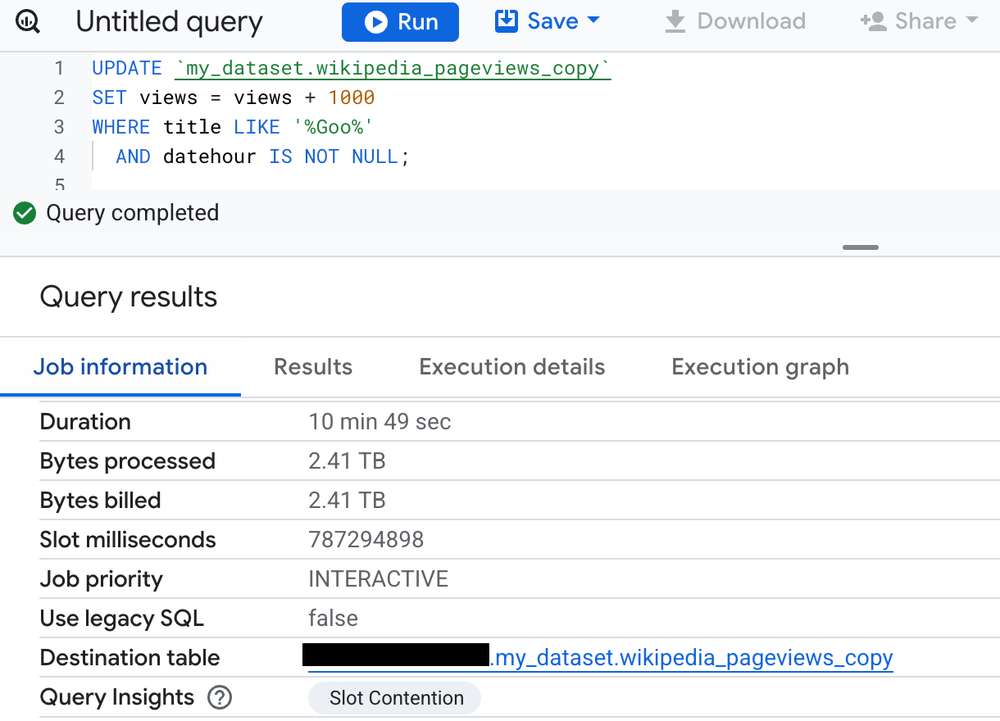
GCP – From analytics to data management: New BigQuery transactional features
For years, BigQuery has been synonymous with fully managed, fast, petabyte-scale analytics. Its columnar architecture and decoupled storage and compute have made it the go-to data warehouse for deriving insights from massive datasets. But what about the moments between the big analyses? What if you need to: Modify a handful of customer records across huge […]