
Azure – App Service virtual network integration multi plan subnet join
We’re excited to announce that the multi plan subnet join for virtual network integration is now available in preview in all regions!
Read More for the details.


We’re excited to announce that the multi plan subnet join for virtual network integration is now available in preview in all regions!
Read More for the details.
Knowledge Bases for Amazon Bedrock is a fully managed Retrieval-Augmented Generation (RAG) capability that allows you to connect foundation models (FMs) to internal company data sources to deliver relevant and accurate responses. We are excited to add new capabilities for building enterprise-ready RAG. Knowledge Bases now supports AWS CloudFormation and Service Quotas.
Read More for the details.
AWS Lambda now supports Amazon Managed Streaming for Apache Kafka (MSK) and self-managed Apache Kafka as event sources in the Asia Pacific (Hyderabad), Asia Pacific (Melbourne), Europe (Spain), Europe (Zurich) Regions, enabling customers to build serverless applications that process streaming data from Kafka event sources.
Read More for the details.
Azure Backup can now help you back up virtual machines using private endpoint-enabled disks. You can now also specify network settings to be used by the restored disks while initiating the restore process.
Read More for the details.
Azure Monitor Agent can now upload to Storage and Event Hubs.
Read More for the details.
Generative AI (gen AI) is well on its way to transforming…well, just about everything. Over the last year, I’ve had the opportunity to meet and speak with hundreds of partners and customers on the topic. We’ve seen how broad gen AI potential is across industries, with use cases spanning fraud detection and response in financial services, product recommendations and summaries in retail, predictive maintenance in manufacturing, content creation and personalization in media, drug discovery in healthcare, and chatbots and intelligent assistants in every sector (just to name a few).
As customers embark on these transformations, they’re looking for help improving their data quality, overhauling privacy safeguards, and hiring AI talent to succeed. To scale how we help customers on their journey, we’re committed to delivering the most open and innovative generative AI partner ecosystem. We are collaborating closely with our customers, enabling a vast number of business users, developers, marketers, and others to benefit from our advanced generative AI products, deep expertise and trusted community of partners to successfully deploy AI efficiently and responsibly.
At Google Cloud Next ‘24 this week, our partners will showcase more than 100 solutions that leverage Google AI to provide meaningful, real-world business value with generative AI. Each of these solutions has been validated by our engineering team. They are listed below with a brief description. Make sure to stop by the partner expo hall at Next to see them live and in-person!
66degrees – Turnkey solutions for gen AI-powered analytics, virtual assistants, migration, document processing, custom applications, and more.
Accenture – Marketing content creation, call center transformation, gen AI-powered software development lifecycle and unstructured document reading.
AI21 Labs – A BigQuery integration that allows users to query data conversationally and get high-quality answers quickly.
Aible – Generative AI and augmented analytics for business teams for structured or unstructured data, in minutes, with guardrails for security and hallucinations.
Aiven – Seamless integration between LLMs and vector databases for augmenting applications, providing better contextual recommendations, and faster issue resolution.
Anthropic – A family of models, Claude 3, that provides state-of-the-art intelligence, speed, cost-efficiency, and vision for enterprise use cases.
Anyscale – An AI platform for developers to speed and scale gen AI, LLMs, and AI/ML apps on the managed Ray framework, eliminating infrastructure complexity.
AODocs – An intelligent chatbot assistant with trusted answers to natural language questions based on SOPs, safety procedures, technical specs, and other docs.
Augmedix – A gen AI-powered solution that helps clinicians save time and focus on patient care by providing ambient medical documentation.
Automation Anywhere – An intelligent, gen AI automation to reduce errors and streamline anti-money laundering processes.
Badal.io – A generative AI compliance solution.
Behavox – LLM-enabled compliance monitoring that decreases false positives and detects real risks.
C3 AI – A unified knowledge source to rapidly find and act on enterprise data and insights through an intuitive search and chat interface.
Capgemini – A gen AI tool that generates personalized and compliant healthcare & medical marketing content, minimizing the medical legal regulatory approval process.
CARTO – A cloud-native spatial analytics platform with built-in gen AI capabilities.
ClearObject – Gen AI-powered solutions to help loan officers find answers to complex policy questions and allow financial analysts to easily extract data from financial reports.
CLOUDSUFI – Data-driven AI solutions that deliver efficient incident resolution and system integrations that optimize productivity and help maintain strategic advantage.
CloudWerx – A multimodal AI tool that combines images, text and expert knowledge to perform complex reasoning tasks and deliver personalized business recommendations.
Cognite – An industrial DataOps platform with gen AI capabilities to help increase productivity, safety, and performance with more trustworthy, accessible industrial data.
Cognizant – Gen AI-powered tools for expedited appeals, marketing content creation, contract generation and configuration, and assisted shopping.
Collibra – A data intelligence platform that authors table and column descriptions, builds data quality rules with NLP and parses and displays transformation details for reports.
Confluent – An AI-powered virtual shopping assistant that allows consumers to find products from pictures or magazine articles.
Dataiku – A generative AI-powered solution that enables users to build a chatbot via a no-code interface.
DataRobot – AI-powered apps that guide applicants through the loan process, even in cases of denial, and an emergency room triage solution to improve patient experience.
DataStax – A gen AI-powered fashion assistant that recommends clothing based on photos, and a support chatbot that helps businesses build their own AI assistants.
Datatonic – A secure, enterprise-grade LLM for organizations to accelerate BI and a natural language query interface for conducting analytics, insights, and presentations.
Deloitte – An app migration platform, a flexible Q&A chatbot for customer service, and a cognitive virtual assistant that can help analyze dashboards.
Denodo – A solution that provides logical data access to all your data for building enterprise data apps.
Egnyte – A tool for project specification document analysis for efficient project management.
Elastic – An interactive, conversational search experience for online shoppers and retailers, tailoring responses to an individual’s unique needs.
Elemental Cognition – AI-powered applications to solve complex operational business problems and accelerate advanced research.
EPAM – A comprehensive indexing and search solution for efficient understanding of video data.
Eviden – A chatbot trained on product user guides to deliver highly accurate answers to retail customers.
Exabeam – A gen AI-powered security operations platform with a threat center that automatically analyzes and investigates events with remediation recommendations.
Fivetran – A trusted data platform that streamlines data ingestion and transformation to support AI workloads and data-driven decision-making.
GitLab – A gen-AI powered DevSecOps solution that helps teams deliver software faster and more securely, using AI for collaboration, development, security, and deployment.
Glean – An AI-powered work assistant that retrieves information from across all company data to generate answers, analyses, and summaries.
Globant – An AI-powered tool for advanced video search, allowing media companies to use text and image search across their vast content libraries.
Grid Dynamics – Hyper-personalized and scalable visual content generation and photo-realistic virtual try-on for enhanced commerce experiences.
GrowthLoop – AI marketing and data activation tools for audience building and customer journey mapping to elevate your campaigns.
Harness – An AI-infused software delivery platform for fast, efficient, and secure AI
HashiCorp – An AI debugger for Terraform that resolves run issues to better identify and remediate developer infrastructure deployment challenges.
HCLTech – Personalized clothing product recommendations with a human-like, conversational experience.
Informatica – A master data management-enhanced gen-AI solution with a conversational AI extension that provides accurate, human-like responses.
Iron Mountain – An AI-powered solution that allows teams to design and deploy production-grade document processing workflows easily and efficiently at scale.
Jasper – AI-powered content creation that helps enterprises scale marketing content while staying on brand.
Kin + Carta – A data excavator that supports manufacturing logistics planning, and a healthcare bot that can answer questions about member policies.
Kyndryl – AI-assisted categorization and extraction of legal documents to dramatically increase productivity.
Labelbox – A solution that provides alternative text descriptions of product images for web embedding, improved product search relevancy, and SEO.
Lucidworks – Industry-specific search and chat applications for improved productivity and revenue outcomes.
Mantle – A company equity platform that accelerates customer onboarding using gen AI to drastically reduce the time it takes to assess and ingest company documents.
McKinsey & Company – A gen AI-powered dashboard application that helps users get operational insights from company data.
Mojix – An item-level visibility solution, powered by an AI engine, that provides insights and control over inventory.
MongoDB – A solution for multimodal sentiment analysis and tagging with MongoDB Atlas and Google LLMs.
Neo4j – A graph database that makes generative AI models more accurate, transparent, and explainable.
NetApp – Intelligent data infrastructure solutions with text summarization, foundation model fine-tuning, and intuitive UIs for easy chatbot interactions.
NVIDIA AI – A full-stack platform that offers the performance, scale, versatility, and enterprise-grade support to minimize TCO and maximize ROI of generative AI projects.
Onix – Manufacturing defect reduction to identify and pinpoint defects in manufacturing and a Chrome extension for generating tabular data summarization from Looker reports.
OpenText – LLM-powered DevOps that delivers software smarter, faster and with lower risk, accelerating application delivery.
Orby AI – Gen AI-powered tools to easily generate scripts and ML models to automate repetitive or complex tasks.
Orca Security – An agentless-first, cloud-native application protection platform that instantly generates remediation code and instructions for alerts.
Pendo.io – AI-powered in-app guide creation that auto-generates guides with just a few clicks.
Persistent Systems – A gen AI-powered financial analysis tool, employing natural language for detailed reports, aiding data-driven decision-making.
Picacity AI– A unified control platform enabling digitizing cities, districts and campuses to derive insights to optimize operational costs, energy efficiency, security and more.
Pinecone.io – A purpose-built vector database built for efficient storage and high-performance vector retrieval to help developers build gen AI applications.
Plainsight – Accelerated document intelligence that increases the speed of customer decision-making.
Pluto7 – Gen AI-enabled data management and smart analytics solutions for inventory and supplier performance visibility.
PwC – A chat assistant that leverages data across systems through enterprise search capabilities for fast, secure data aggregation and cross-referencing.
Quantiphi – A gen AI platform for knowledge worker productivity and a chat interface with multi-lingual personalized recipe suggestions and store recommendations.
Quantum Metric – A gen AI-powered platform that summarizes thousands of data points collected in a user’s digital session and consolidates them into a short summary.
Redis – A chatbot for customer support for financial services, systems and code technical support, and virtual assistance for customer retail purchases.
Replit – An AI-powered platform that enables developers to build software faster, collaboratively, and from any machine.
SADA – An AI-powered knowledge engine which provides immediate, precise insights tailored to your unique role in sales, customer service, research, or marketing.
SantoDigital – A chat interface to ask questions and search for ideas to generate content, automate tasks, and optimize processes across industries.
SAP – Modernized cloud ERP capabilities to support the development and deployment of enterprise AI and conversational AI.
SingleStore – A data platform that enables building gen AI and real-time analytics apps by empowering customers to transact, analyze and contextualize their data in real-time.
Slalom – Multimodal, AI-enablement of a mobile robot to perform inventory management and quality inspections with high precision.
Snorkel AI – A tool that customizes an intent classification model using programmatic data curation to power banking chatbots with production-quality accuracy.
SoftServe – A solution for analyzing and streamlining compliance documentation and processes and an AI assistant that creates personalized role-play conversations.
Sorcero – A solution enabling life sciences companies to transform disparate medical data into high-quality, instant insights and medical information to improve patient care.
Sprinklr – Gen AI-powered CCaaS enhancements to enrich customer data for deeper insights, better decisions, and faster actions.
Tamr – An application to clean and organize golden records, leveraging generative AI to interpret long manually-entered text.
Tata Consultancy Services – AI assistant solutions leveraging gen AI for contracts, product insights, retail, policy, and procurement.
Tecton – A platform to accelerate the development of predictive or generative AI machine learning applications
ThoughtSpot – An AI-driven insights engine with a 360° view of business changes and natural language insight narratives.
Thoughtworks – An event planning solution that uses data and predictive capabilities for event recommendations to help event planners enhance their productivity.
TTEC Digital – A conversational intelligence solution for seamless self-service support experiences, powered by virtual agents.
Typeface – An enterprise generative AI platform for personalized content creation.
UiPath – AI-powered automation for HR hiring processes to improve company and candidate experiences.
UKG – AI solutions that support great workplaces by enhancing culture and productivity, particularly for frontline employees.
V7 – An AI-assisted solution that automatically labels multimodal data without the need for ML expertise.
Weights & Biases – Developer tools to create and fine-tune generative AI models, accelerating productivity and collaboration of ML researchers.
Zencore – Solutions for fast video transcription, subtitling, image generation, and efficient document information extraction.
Our partners are building new gen AI applications and models, powering new features in their platforms with Gemini, Vertex AI and BigQuery, launching new data offerings, and scaling important implementation services that will help customers see value from gen AI more quickly. Join us on the show floor or virtually at Google Cloud Next ‘24 to explore how your organization can accelerate time to value with generative AI. Finally, see how you can simplify discovery, procurement, and deployment of our partners’ generative AI solutions on Google Cloud Marketplace.
Read More for the details.
The results are finally in. Allow us to proudly present to you the 2024 Google Cloud Partner of the Year winners!
It’s a pleasure and an honor to acknowledge the tremendous contributions our partners make to our business. These organizations go above and beyond to create outstanding solutions and experiences for every single one of our customers. We’d like to thank the winners for their creative spirit, collaborative drive, and customer-first approach.
Please join us in congratulating all the winners!
With this award, we are proud to recognize global partners at the top of their respective categories who have led with a customer-first vision and created industry-leading solutions with Google Cloud.
The partners who won this award have provided exceptional service and enabled their customers’ success by innovating, building, and delivering the right combination of Google Cloud solutions.
The winners of this award are partners who have achieved outstanding success selling Google Cloud products and building relationships to help transform their customers’ businesses.
The partners who received this award used a winning combination of Google Cloud technology in a specific technology segment to deliver innovative solutions and customer satisfaction.
These partners leveraged Google Cloud solutions to create comprehensive and compelling services solutions that made a significant impact in one industry across multiple regions.
These partners leveraged Google Cloud solutions to create comprehensive and compelling technology solutions that made a significant impact in one industry across multiple regions.
This award recognizes partners with a Specialization that excelled in their Specialization area throughout 2023, resulting in substantial success for their customers.
The winners of this award are partners who are committed to growing and promoting their team’s cloud skills through training, upskilling, and reskilling their workforce on leading-edge cloud technology with Google Cloud certifications.
Over the past year, these award winners emerged and expanded their partnership with Google Cloud, resulting in innovative breakthroughs and noteworthy growth in their customer base or revenue.
This award recognizes partners that have provided exceptional training services and enabled customer success by innovating, building, and delivering the right combination of Google Cloud solutions through learning.
During 2023, these partners saw outstanding success by helping a large number of customers achieve better results through Google Cloud.
This award recognizes partners that have provided superior service and enabled the success of their public sector customers by innovating, building, and delivering the right combination of Google Cloud solutions.
At Google, we know that championing diversity, equity, and inclusion in our work is not only the right thing to do but critical to our success. The following winners prioritized these pillars, leading to better discussions, decisions, and outcomes for everyone.
With this award, we recognize partners that went above and beyond in 2023 to create or promote initiatives that made a positive and lasting impact on our world.
These partners in Southeast Asia had a phenomenal impact on their customers’ success selling the right combination of Google Cloud products and solutions while providing exceptional service.
Read More for the details.
Action recommended: Prepare for model version retirement in Azure OpenAI
Read More for the details.
AWS Transfer Family now provides an interactive workshop for building file transfer solutions using Secure File Transfer Protocol (SFTP). With this workshop in AWS Workshop Studio, you can learn how to build secure and automated business-to-business file transfer workflows in AWS, and integrate data from remote business partners in your applications and data lakes.
Read More for the details.
Amazon CloudWatch now supports using AWS CloudFormation to manage tags when you create, update, or delete alarms.
Read More for the details.
Starting today, customers can use Amazon Cognito in Asia Pacific (Melbourne) Region. Amazon Cognito makes it easy to add authentication, authorization, and user management to your web and mobile apps. Amazon Cognito scales to millions of users and supports sign-in with social identity providers such as Apple, Facebook, Google, and Amazon, and enterprise identity providers via standards such as SAML 2.0 and OpenID Connect.
Read More for the details.
Today, AWS announces that CodeCatalyst Issues now support breaking down issues into smaller units called tasks. CodeCatalyst customers can now add up to 100 tasks within a single issue to further organize and plan out the work involved. Tasks can be added when creating a new issue or later added to existing issues and can be assigned to any of the project members. You can also reorder, mark as complete, or remove tasks on an issue.
Read More for the details.
Starting today, you can use the Secure Reliable Transport (SRT) protocol to broadcast to your Amazon Interactive Video Service (Amazon IVS) channels. This new protocol, in addition to RTMPS, expands options for live streaming and helps to maintain video quality when sent across varying network conditions.
Read More for the details.
Today we’re excited to announce the release of Research and Engineering Studio (RES) on AWS Version 2024.04. This latest release brings new customization options for RES virtual desktops along with new options for shared storage and virtual desktop infrastructure (VDI) streaming.
Read More for the details.
You can now leverage tag-based subnet discovery capability of Amazon VPC CNI to scale Amazon Elastic Kubernetes Service (EKS) clusters in IPv4 address space without adding operational complexity. In this new default mode, Kubernetes Pod IP addresses are allocated from all tagged and available subnets in your Amazon Virtual Private Cloud(VPC).
Read More for the details.
AWS has launched a feature for Amazon Cognito customers to reduce the time spent securing Amazon API Gateway APIs with fine-grained access control, from weeks to days. The feature leverages Amazon Verified Permissions to manage and evaluate granular security policies that reference user attributes and groups. With a few clicks, you can enforce that only users in authorized Amazon Cognito groups have access to the application’s APIs. For example, say you are building a loan processing application, you can secure your application by restricting access to the “approve_loan” API to users in the “loan_officers” group. You can implement more fine-grained authorization, without making any code changes, by updating the underlying Cedar policy, so that only “loan_officers” above “Director” level can approve loans.
Read More for the details.
Google Cloud Next ‘24 is right around the corner, and this year, there will be even more for developers to enjoy. Whether you’re on the generative AI kick or keeping up with what’s new with Javascript frameworks, there’s a session for technical practitioners in the Application Developers Zone! Meet the experts and get inspired to solve your biggest technical challenges over three days in Las Vegas, April 9-11. With over 600 sessions available, you can choose from a wide range of topics, covering everything from security to growing revenue with AI.
Here are a few of the sessions you won’t want to miss:
1. Building generative AI apps on Google Cloud with LangChain
Learn how to use LangChain, the most popular open-source framework for building LLM-based apps, on Cloud Run to add gen AI features to your own applications. See how to combine it with Cloud SQL’s pgvector extension for vector storage to quickly locate similar data points with vector search and reduce the cost of deploying models with Vertex Endpoints.
2. How to deploy all the JavaScript frameworks to Cloud Run
Join this session, where we’ll deploy as many JavaScript frameworks as we can, including Angular, React, and Node.js, as quickly as we can to prove that it can be done and have some fun!
3. Build full stack applications using Firebase & Google Cloud
Discover how Firebase and Google Cloud simplify full-stack development, empowering you to rapidly build scalable, enterprise-grade applications.
4. Get developer assistance customized to your organization code with Gemini
Join Gemini product managers and Capgemini to learn how to customize Duet AI with your own private codebase and bring AI code assistance to your development teams.
Also be sure to check out the Innovators Hive — a central hub where you can discover what’s new and next at Google Cloud — to dive into interactive demos and talk face-to-face with our developer experts. Here are a few of the demos you can expect to find in the Innovators Hive AppDev zone:
Write your own Cloud Functions (with the help of Duet AI/Gemini) to interact with our programmable pinball machine that uses Pub/Sub to collect events from the game in real time.
Learn all about serving a Gemma large language model using graphical processing units (GPUs) on Google Kubernetes Engine (GKE) Autopilot, working with the 2B and 7B parameter models in particular.
There’s so much more to enjoy at Next ‘24 that you’ll have to see it to believe it. And if you can’t go in person, you can still register for a digital pass, and access keynotes, 100+ breakout sessions on demand.
Read More for the details.
Google Cloud Next ‘24 is around the corner, and it’s the place to be if you’re serious about cloud development! Starting April 9 in Las Vegas, this global event promises a deep dive into the latest updates, features, and integrations for the services of Google Cloud’s managed container platform, Google Kubernetes Engine (GKE) and Cloud Run. From effortlessing scaling and optimizing AI models to providing tailored environments across a range of workloads — there’s a session for everyone. Whether you’re a seasoned cloud pro or just starting your serverless journey, you can expect to learn new insights and skills to help you deliver powerful, yet flexible, managed container environments in this next era of AI innovation.
Don’t forget to add these sessions to your event agenda — you won’t want to miss them.
OPS212: How Anthropic uses Google Kubernetes Engine to run inference for Claude
Learn how Anthropic is using GKEs resource management and scaling capabilities to run inference for Claude, its family of foundational AI models, on TPU v5e.
OPS200: The past, present, and future of Google Kubernetes Engine
Kubernetes is turning 10 this year in June! Since its launch, Kubernetes has become the de facto platform to run and scale containerized workloads. The Google team will reflect on the past decade, highlight how some of the top GKE customers use our managed solution to run their businesses, and what the future holds.
DEV201: Go from large language model to market faster with Ray, Hugging Face, and LangChain
Learn how to deploy Retrieval-Augmented Generation (RAG) applications on GKE using open-source tools and models like Ray, HuggingFace, and LangChain. We’ll also show you how to augment the application with your own enterprise data using the pgvector extension in Cloud SQL. After this session, you’ll be able to deploy your own RAG app on GKE and customize it.
DEV240: Run workloads not infrastructure with Google Kubernetes Engine
Join this session to learn how GKE’s automated infrastructure can simplify running Kubernetes in production. You’ll explore cost -optimization, autoscaling, and Day 2 operations, and learn how GKE allows you to focus on building and running applications instead of managing infrastructure.
OPS217: Access traffic management for your fleet using Google Kubernetes Engine Enterprise
Multi-cluster and tenant management are becoming an increasingly important topic. The platform team will show you how GKE Enterprise makes operating a fleet of clusters easy, and how to set up multi-cluster networking to manage traffic by combining it with the Kubernetes Gateway API controllers for GKE.
OPS304: Build an internal developer platform on Google Kubernetes Engine Enterprise
Internal Developers Platforms (IDP) are simplifying how developers work, enabling them to be more productive by focusing on providing value and letting the platform do all the heavy lifting. In this session, the platform team will show you how GKE Enterprise can serve as a great starting point for launching your IDP and demo the GKE Enterprise capabilities that make it all possible.
DEV205: Cloud Run – What’s new
Join this session to learn what’s new and improved in Cloud Run in two major areas — enterprise architecture and application management.
DEV222: Live-code an app with Cloud Run and Flutter
During this session, see the Cloud Run developer experience in real time. Follow along as two Google Developer Relations Engineers live-code a Flutter application backed by Firestore and powered by an API running on Cloud Run.
DEV208: Navigating Google Cloud – A comprehensive guide for website deployment
Learn about the major options for deploying websites on Google Cloud. This session will cover the full range of tools and services available to match different deployment strategies — from simple buckets to containerized solutions to serverless platforms like Cloud Run.
DEV235: Java on Google Cloud — The enterprise, the serverless, and the native
In this session, you’ll learn how to deploy Java Cloud apps to Google Cloud and explore all the options for running Java workloads using various frameworks.
DEV237: Roll up your sleeves – Craft real-world generative AI Java in Cloud Run
In this session, you’ll learn how to build powerful gen AI applications in Java and deploy them on Cloud Run using Vertex AI and Gemini models.
DEV253: Building generative AI apps on Google Cloud with LangChain
Join this session to learn how to combine the popular open-source framework LangChain and Cloud Run to build LLM-based applications.
DEV228: How to deploy all the JavaScript frameworks to Cloud Run
Have you ever wondered if you can deploy JavaScript applications to Cloud Run? Find out in this session as one Google Cloud developer advocate sets out to prove that you can by deploying as many JavaScript frameworks to Cloud Run as possible.
DEV241: Cloud-powered, API-first testing with Testcontainers and Kotlin
Testcontainers is a popular API-first framework for testing applications. In this session, you’ll learn how to use the framework with an end-to-end example that uses Kotlin code in BigQuery and PubSub, Cloud Build, and Cloud Run to improve the testing feedback cycle.
ARC104: The ultimate hybrid example – A fireside chat about how Google Cloud powers (part of) Alphabet
Join this fireside chat to learn about the ultimate hybrid use case — running Alphabet services in some of Google Cloud’s most popular offerings. Learn how Alphabet leverages Google Cloud runtimes like GKE, why it doesn’t run everything on Google Cloud, and the reason some products run partially on cloud.
DEV221: Use Firebase for faster, easier mobile application development
Firebase is a beloved platform for developers, helping them develop apps faster and more efficiently. This session will show you how Firebase can accelerate application development with prebuilt backend services, including authentication, databases and storage.
DEV243: Build full stack applications using Firebase and Google Cloud
Firebase and Google Cloud can be used together to build and run full stack applications. In this session, you’ll learn how to combine these two powerful platforms to enable enterprise-grade applications development and create better experiences for users.
DEV107: Make your app super with Google Cloud Firebase
Learn how Firebase and Google Cloud are the superhero duo you need to build enterprise-scale AI applications. This session will show you how to extend Firebase with Google Cloud using Gemini — our most capable and flexible AI model yet — to build, secure, and scale your AI apps.
DEV250: Generative AI web development with Angular
In this session, you’ll explore how to use Angular v18 and Firebase hosting to build and deploy lightning-fast applications with Google’s Gemini generative AI.
See you at the show!
Read More for the details.
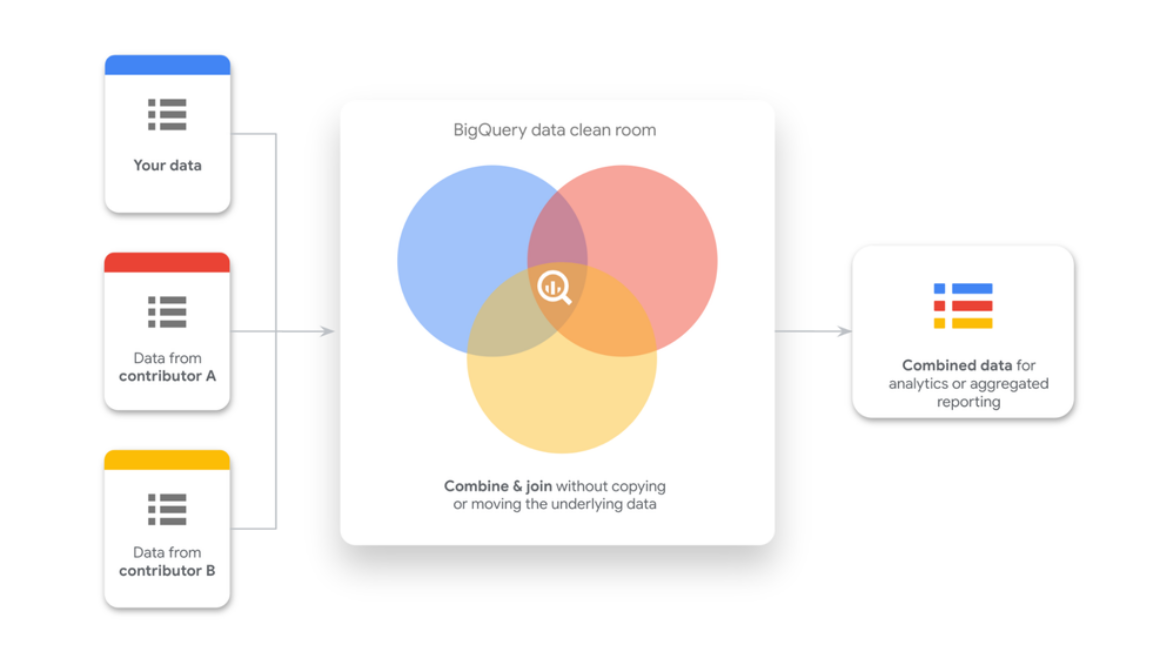
The rise of data collaboration and use of external data sources highlights the need for robust privacy and compliance measures. In this evolving data ecosystem, businesses are turning to clean rooms to share data in low-trust environments. Clean rooms enable secure analysis of sensitive data assets, allowing organizations to unlock insights without compromising on privacy.
To facilitate this type of data collaboration, we launched the preview of data clean rooms last year. Today, we are excited to announce that BigQuery data clean rooms is now generally available.
Backed by BigQuery, customers can now share data in place with analysis rules to protect the underlying data. This launch includes a streamlined data contributor and subscriber experience in the Google Cloud console, as well as highly requested capabilities such as:
Join restrictions: Limits the joins that can be on specific columns for data shared in a clean room, preventing unintended or unauthorized connections between data.
Differential privacy analysis rule: Enforces that all queries on your shared data use differential privacy with the parameters that you specify. The privacy budget that you specify also prevents further queries on that data when the budget is exhausted.
List overlap analysis rule: Restricts the output to only display the intersecting rows between two or more views joined in a query.
Usage metrics on views: Data owners or contributors see aggregated metrics on the views and tables shared in a clean room.
Using data clean rooms in BigQuery does not require creating copies of or moving sensitive data. Instead, the data can be shared directly from your BigQuery project and you remain in full control. Any updates you make to your shared data are reflected in the clean room in real-time, ensuring everyone is working with the most current data.
BigQuery data clean rooms are available in all BigQuery regions. You can set up a clean room environment using the Google Cloud console or using APIs. During this process, you set permissions and invite collaborators within or outside organizational boundaries to contribute or subscribe to the data.
When sharing data into a clean room, you can configure analysis rules to protect the underlying data and determine how the data can be analyzed. BigQuery data clean rooms support multiple analysis rules including aggregation, differential privacy, list overlap, and join restrictions. The new user experience within Cloud console lets data contributors configure these rules without needing to use SQL.
Lastly, by default, a clean room employs restricted egress to prevent subscribers from exporting or copying the underlying data. However, data contributors can choose to allow the export and copying of query results for specific use cases, such as activation.
The data owner or contributor is always in control of their respective data in a clean room. At any time, a data contributor can revoke access to their data. Additionally, as the clean room owner, you can adjust access using subscription management or privacy budgets to prevent subscribers from performing further analysis. Additionally, data contributors receive aggregated logs and metrics, giving them insights into how their data is being used within the clean room. This promotes both transparency and a clearer understanding of the collaborative process.
Customers across all industries are already seeing tremendous success with BigQuery data clean rooms. Here’s what some of our early adopters and partners had to say:
“With BigQuery data clean rooms, we are now able to share and monetize more impactful data with our partners while maintaining our customers’ and strategic data protection.” – Guillaume Blaquiere, Group Data Architect, Carrefour
“Data clean rooms in BigQuery is a real accelerator for L’Oréal to be able to share, consume, and manage data in a secure and sustainable way with our partners.” – Antoine Castex, Enterprise Data Architect, L’Oréal
“BigQuery data clean rooms equip marketing teams with a powerful tool for advancing privacy-focused data collaboration and advanced analytics in the face of growing signal loss. LiveRamp and Habu, which independently were each early partners of BigQuery data clean rooms, are excited to build on top of this foundation with our combined interoperable solutions: a powerful application layer, powered by Habu, accelerates the speed to value for technical and business users alike, while cloud-native identity, powered by RampID in Google Cloud, maximizes data fidelity and ecosystem connectivity for all collaborators. With BigQuery data clean rooms, enterprises will be empowered to drive more strategic decisions with actionable, data-driven insights.” – Roopak Gupta, VP of Engineering, LiveRamp
“In today’s marketing landscape, where resources are limited and the ecosystem is fragmented, solutions like the data clean room we are building with Google Cloud can help reduce friction for our clients. This collaborative clean room ensures privacy and security while allowing Stagwell to integrate our proprietary data to create custom audiences across our product and service offerings in the Stagwell Marketing Cloud. With the continued partnership of Google Cloud, we can offer our clients integrated Media Studio solutions that connect brands with relevant audiences, improving customer journeys and making media spend more efficient.” – Mansoor Basha, Chief Technology Officer, Stagwell Marketing Cloud
“We are extremely excited about the General Availability announcement of BigQuery data clean rooms. It’s been great collaborating with Google Cloud on this initiative and it is great to see it come to market.. This release enables production-grade secure data collaboration for the media and advertising industry, unlocking more interoperable planning, activation and measurement use cases for our ecosystem.” – Bosko Milekic, Chief Product Officer, Optable
Whether you’re an advertiser trying to optimize your advertising effectiveness with a publisher, or a retailer improving your promotional strategy with a CPG, BigQuery data clean rooms can help. Get started today by using this guide, starting a free trial with BigQuery, or contacting the Google Cloud sales team.
Read More for the details.
We are excited to announce that differential privacy enforcement with privacy budgeting is now available in BigQuery data clean rooms to help organizations prevent data from being reidentified when it is shared.
Differential privacy is an anonymization technique that limits the personal information that is revealed in a query output. Differential privacy is considered to be one of the strongest privacy protections that exists today because it:
is provably private
supports multiple differentially private queries on the same dataset
can be applied to many data types
Differential privacy is used by advertisers, healthcare companies, and education companies to perform analysis without exposing individual records. It is also used by public sector organizations that comply with the General Data Protection Regulation (GDPR), the Health Insurance Portability and Accountability Act (HIPAA), the Family Educational Rights and Privacy Act (FERPA), and the California Consumer Privacy Act (CCPA).
With differential privacy, you can:
protect individual records from re-identification without moving or copying your data
protect against privacy leak and re-identification
use one of the anonymization standards most favored by regulators
BigQuery customers can use differential privacy to:
share data in BigQuery data clean rooms while preserving privacy
anonymize query results on AWS and Azure data with BigQuery Omni
share anonymized results with Apache Spark stored procedures and Dataform pipelines so they can be consumed by other applications
enhance differential privacy implementations with technology from Google Cloud partners Gretel.ai and Tumult Analytics
call frameworks like PipelineDP.io
BigQuery differential privacy is three capabilities:
Differential privacy in GoogleSQL – You can use differential privacy aggregate functions directly in GoogleSQL
Differential privacy enforcement in BigQuery data clean rooms – You can apply a differential privacy analysis rule to enforce that all queries on your shared data use differential privacy in GoogleSQL with the parameters that you specify
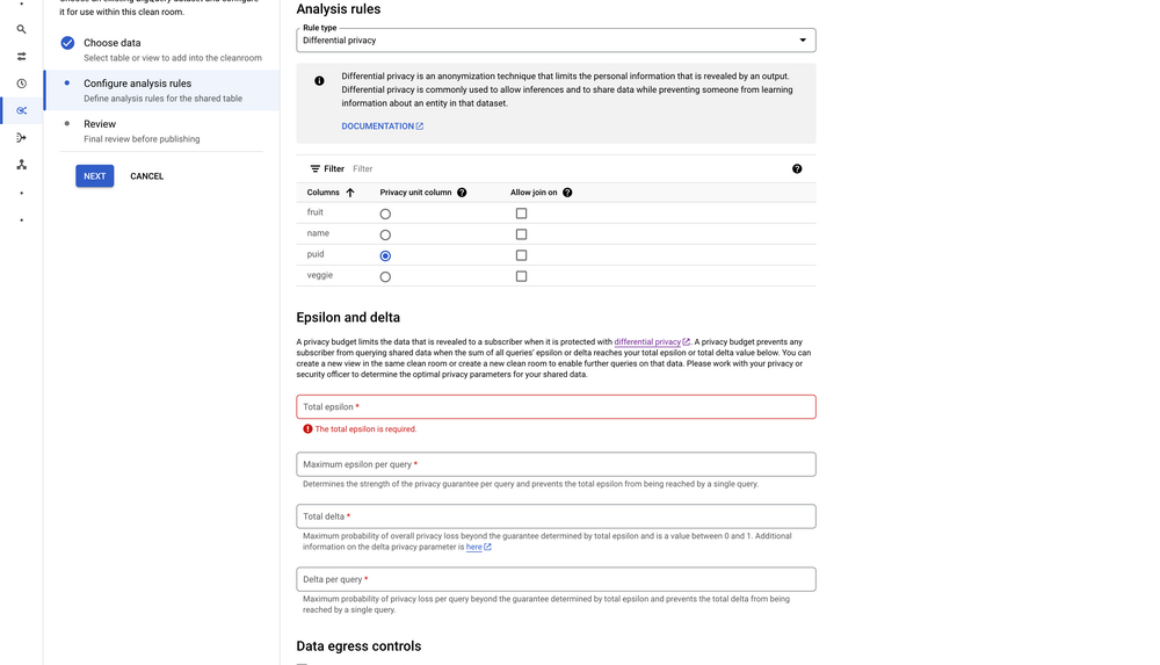
Parameter-driven privacy budgeting in BigQuery data clean rooms – When you apply a differential privacy analysis rule, you also set a privacy budget to limit the data that is revealed when your shared data is queried. BigQuery uses parameter-driven privacy budgeting to give you more granular control over your data than query thresholds do and to prevent further queries on that data when the budget is exhausted.
Here’s how to enable the differential privacy analysis rule and configure a privacy budget when you add data to a BigQuery data clean room.
Subscribers of that clean room must then use differential privacy to query your shared data.
Subscribers of that clean room cannot query your shared data once the privacy budget is exhausted.
BigQuery differential privacy is configured when a data owner or contributor shares data in a BigQuery data clean room. A data owner or contributor can share data using any compute pricing model and does not incur compute charges when a subscriber queries that data. Subscribers of a data clean room incur compute charges when querying shared data that is protected with a differential privacy analysis rule. Those subscribers are required to use on-demand pricing (charged per TB) or the Enterprise Plus edition (charged per slot hour).
Create a clean room where all queries are protected with differential privacy today and let us know where you need help.
Read More for the details.